
Beloved Community
I believe that to be human is to be inherently connected to your own self, to those around you, and to all of creation. We live in a global culture that is shaped primarily by people with extreme wealth and a vision for an extractive, lonely, individualistic present and future. But in the words of musician and author, Andre Henry, “it doesn’t have to be this way.”
In 2026, I find myself obsessing, if I’m honest, over the ways in which our resources are being extracted and exploited by those in power. At the most basic level, I’m talking about money. But I’m also talking about and thinking about our time, our attention, our data. For now, this page is an ever-growing resource for ways to reclaim and redistribute our resources for the flourishing of all creation.
“‘The Beloved Community’ is a term that was first coined in the early days of the 20th Century by the philosopher-theologian Josiah Royce, who founded the Fellowship of Reconciliation. However, it was Dr. Martin Luther King, Jr., also a member of the Fellowship of Reconciliation, who popularized the term and invested it with a deeper meaning which has captured the imagination of people of goodwill all over the world…Dr. King’s Beloved Community is a global vision, in which all people can share in the wealth of the earth. In the Beloved Community, poverty, hunger and homelessness will not be tolerated because international standards of human decency will not allow it.”

Five Dollar Fridays
This initiative is inspired by Bookstagram creator and podcast host, Traci Thomas of The Stacks Pod. Each first (or second) Friday of the month, at least through the end of 2026, I will highlight an organization that’s doing the work, and invite you all alongside me to give a gift of $5 (more is obviously always welcome, but $5 is truly enough). Living through such an onslaught of terribleness, it is so easy to be paralyzed by overwhelm. But if we all take little steps in the same direction, they become big, massive steps collectively. We all can start some place.
February
Kweli exists “to nurture emerging BIPOC writers that ‘sing the truth,’ with a quarterly online literary journal, year-long writer fellowships, multi-session workshops, writing retreats, individualized editing, an anuual writers’ conference and international festival.”
There’s a reason book banning is so popular in oppressive, fascist regimes, why enslaved folks weren’t allowed to read, why our government is always finding new and creative ways to divest from public education. Literacy is power. Reading, especially fiction, builds deep empathy. Reading connects the dots. The writers and artists have always been the truth-tellers among us.
March
“Our food is vegan & free. We feed workers on strike, folks sleeping rough, & families on the block.”
Over the years of being connected to Jeff and the work of Food Not Bombs, South Philly, I know they have also pitched in to supplement rent for individuals facing eviction or needing a new place on short notice, connected folks to employment, provided financial support for legal services for things from immigration to criminal legal defense. They are the epitome of grassroots neighborhood love and care, and every dollar goes directly to the people.
April
“The Black Mamas Matter Alliance (BMMA) is a Black women-led cross-sectoral alliance that centers Black mamas and birthing people to advocate, drive research, build power, and shift culture for Black maternal health, rights, and justice.
Our goals:
Change Policy
Cultivate Research
Advance Care for Black Mamas
Shift Culture”
Black Maternal Health Week takes place in April! I don’t know what it will take to improve the care and outcomes for Black birthing people and their babies but I am grateful for every effort in that direction and committed to engaging the work in the role of doula and advocate. Black Mamas Matter has been doing the work since 2013 and has channeled the efforts of a brilliant, diverse cast of femmes across disciplines towards making this country a better place for Black people to birth and live.

May
The DAIR (Distributed AI Research) Institute
AI feels like this inevitability. In some ways it is. It’s impossible to put the toothpaste back in the tube. There are lots of ways to resist, including refusal to adopt. And also, there are people who are leaning in to reclaim whatever dignity and ethics might be possible within this new world order. And we need that, too, as much as I wish we could put the toothpaste back into the tube altogether.
“The Distributed AI Research Institute is an independent organization conducting community-rooted research. We are a globally distributed group of academics, activists, and engineers who believe in technology that benefits everyone.
We believe that research should center the people most impacted by technology and should be rooted in community needs. As a globally-distributed team, we're able to remain embedded in our communities worldwide, and to include a greater diversity of perspectives and lived experiences to inform our research and other projects…”
You can read more on their website linked above.
June
Where Stories Meet Community
“A Black feminist homecoming. Gladys Books & Wine offers a curated space for Black queer literature, author events, community programming, and meaningful connections. All over sips of natural wine.”
Gladys, approaching their first birthday in the BedStuy community, has recently struggled with severe flooding, and is having a difficult time navigating repairs with their landlord. They’ve had to reduce store operating hours, cutting into their profits, and all on the eve of Pride. Please consider giving to their Go Fund Me, in order to keep this institution in the community.
August
“Founded in April 2024 by Palestinians in exile. We work with the most disenfranchised communities in Gaza, listening to what they need and delivering aid that fuels liberation.”
Gaza is still under seige. Every bit helps.
Sameer project is a vetted org founded and run by Palestinians. I learned about them through Wear The Peace, which I also wholeheartedly recommend for purchasing clothing/accessories.

September
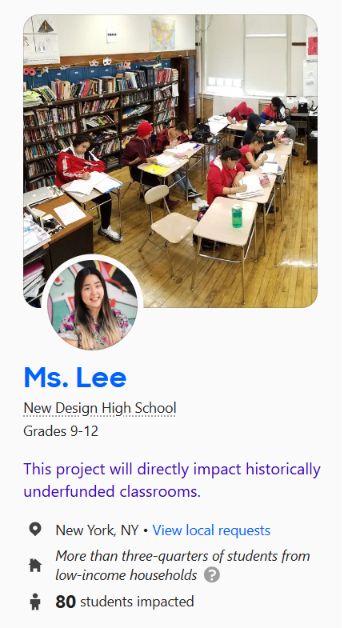
Alexa Lee is a friend of mine, and a dedicated NYC public school teacher. She is entering her 17th year in the classroom. She presently teaches 12th grade English on the Lower East Side, in a school comprised primarily of students of color.
It has been such a delight to follow her journey with her students over the years, to hear about the thoughtful, holistic ways she engages them, through projects, field trips, and an unwavering commitment to meeting them where they are, purposefully representing them in the material they engage, and instilling within them a sincere belief in their capability. Consider joining me in supporting her classroom library expansion this year! You can also take a look at the full list of books requested here. Not all of the requested books are available through Donors Choose. I also plan to make good use of my bookstore discount at the end of this month’s campaign to contribute to the library. If you’d like to Venmo me directly to contribute to that effort, you can do so at @genay-jackson.
October
to come!to come!November
Divestment and Investment
A better future is only possible when we are both honest and intentional about tearing down harmful structures and building up new, beautiful beacons of the world we want to see and live in.
Divestment can feel incredibly overwhelming when we actually come to understand how much so many of the pieces of our daily lives are tied to both human and environmental harm. For example, those cute lil Ball mason jars that I LOVE…weapons manufacturing! We were watching a Denver Nuggets game a couple of seasons ago and I realized their arena is named after Ball, and I thought to myself, “how’d mason jars create pro-ball arena wealth?” so I googled, and here we are. It is EVERYWHERE! It’s depressingly impossible to keep up. This has been a years-long and still ongoing - truly one decision at a time - process for our family (and we still have a ways to go).
I will admit honestly that the two places where I am an absolutely horribly annoying dogmatist about divestment are:
Amazon - exploitation of workers (low-wages, poor, unsafe working conditions with a disporportionate impact on Black workers, and union-busting), environmental harm (packaging, carbon emissions),intentional model that absorbs and drives smaller businesses to closure, while stealing product design, and truly supercharging the era of instant gratification and fabricated urgency.
AI-products, such as ChatGPT, Gemini, and other “assistants” and social media-based chat products - extreme environmental harm (unprecedented water use, ground water contamination, noise and air pollution, almost exclusively impacting poor communities and Black communities, and increased electric costs passed on to regular people), exploitation of children and others (“undress” features, inappropriate sexually-charged conversations, output “hallucinations” that are not flagged as such, the design is explicitly to continue to agree with the sentiments of the user to keep the user engaged, documented “psychosis” attributed to ongoing use in isolation), exploitation of workers in the Global South who are paid low wages to moderate harmful content and absorb the tedium required for “AI” to actually function, negative impact on artists, and honest marketing about its sole purpose to help us think less as it is very strategically pushed to ‘the masses’, while those with power and social capital abstain.
For everything else, I want to invite you into the not at all perfect, and full of compromises journey we’ve been on to be intentional about how our resources shape the world we’d like to see. Ultimately, this process has served to help us pause, research, and consider before we spend, and in many ways to simply end up buying less.
-
I totally get the convenience of Big Box. Our divestment journey was first Walmart, then Amazon, and now Target (mostly). The first two were much easier. Target as the most beloved, and honestly last frontier of convenience and relative good (they have a better reputation for staff compensation and benefits at least and were not contributing to right-wing political campaigns), has been a more challenging journey in light of their rollback on their commitment to DEI, and their implicit permission of ICE operations.
In the last year, we’ve pivoted about 90% of our Target spending, and have stopped using Target Circle so that they cannot track our spending/customer loyalty.
In general, these are what some of the transitions have looked like:
Buying products directly from the brand website, when possible
Ex. Black Friday, I took advantage of the sales on the sites of our hair care products, body lotion and wash, and my skin care products, and just stocked up for months
Waiting for sales at different retailers (like for furniture or household items) to buy higher quality, more sustainably made products
Books:
print from Independent Bookstores or Bookshop.org
audio from Libro.fm
I don’t read a ton of e-books. They are available through Bookshop.org. I do have a Kindle Unlimited account, which is the only way to support Indie authors (romance in my case), and only use it to read books I can’t purchase elsewhere.
Household cleaning prouducts: Grove collaborative subscription
A laundry list of terrific small businesses I’ve accumulated over the years (local, friends, getting got by Instagram ads)
-
NYC has a slightly different grocery scene than many places. We would actually do a lot of our grocery shopping at Target as well.
I used to love (and had my first job back in the day!) Whole Foods but they are now owned by Amazon, which has diminished the quality of many of the products and reduced the quality of life for employees.
Wegmans’ presence is growing! They are generally good, and are committed to using local farmers when they can but they have just instituted facial recognition across, at least their NYC stores, if not elsewhere as well.
Where we try to fill most of our needs:
A grocery delivery service called Hungryroot that provides recipes and grocery items. *Pros: Many of the items are Hungryroot brand, keeping those items relatively affordable. It has helped reduce the mental energy of meal planning. They have a variety of diet-specific options, and customer service has been responsive. We’ve used them for about 3 years. *Cons: the produce is usually not great quality
Local farmers market *Pros: eat seasonally and cleanly, high quality meat and produce, support local farmers, they also accept SNAP, and usually have provisions for composting *Cons: as costs are higher, you may need to pick and choose
Trader Joes *Pros: lowest cost grocery option by a mile, the snacks and grab and go options are fabulous, the staff are generally lovely to interact with and well-compensated (many stores are unionized) *Cons: produce and meats aren’t the highest quality, accusations of union-busting at some stores, accusations of recipe stealing; still a lot of processed food options
Neighborhood grocery store *Pros: pouring money back into the local community, sheer convenience *Cons: prices are often significantly higher, lower quality meats and produce
Coffee: Trade Coffee Subscription, supplemented with coffee from the store that’s transparent about farming and sourcing practices; local coffee shops
I also recommend understanding the practices of some of the biggest producers of grocery products and thinking about if there are ways to pivot, companies like Nestle and Driscoll to name a couple
-
While we really can’t do with less food, we can all totally do with less clothing.
I, as I’m sure you do as well, get a TON of Instagram ads for fashion brands. As there has been more scrutiny placed on the fast fashion industry, companies that do not utilize business practices that are environmentally sound or who do not have pay transparency all the way through their supply chain often try to disguise those short-comings with vague empowerment mission statements and initiatives but no real transparency.
There are tons of brands that are clear. There are also many who have achieved B Corp Certification (you can look for the little capital B in a circle) that affirms that they meet certain standards of operation. (This is not just for clothing but for a whole host of industries (Bookshop.org, Libro.fm, Ben & Jerry’s, my favorite ginger pineapple drinks made by JustMade, are all BCorps)
I would love to be a thrifter but alas I am not. I encourage it though, as a super sustainable practice, and maybe one day I’ll get it together! I also own that not every new purchase meets even my standards but we’re trying. In the meantime, some brands I’ve pivoted to (that are often having sales, if my inbox is any indication), are:
Athleta (athleisure for the girls and me)
Madewell (my jeans); they also buy your used denim, even if you didn’t buy it there
VEJA and On (my sneakers)
Wear the Peace (clothing with a message)
Bombas (socks and underwear)
Patagonia (outerwear)
Catbird NYC (jewelry)
Donating old, good condition clothing and Trashie Take Back Bags to recycle clothing that is not in a condition to donate
-
It is HARD. It is literally the water we’re swimming in. I do not have a good or easy solution but an encouragement to take care.
We’ve abandoned Twitter (yes, everyone except X deserves to be called by their chosen name!) and TikTok, though here we are still on Mark Zuckerberg’s internets. We are, admittedly, dragging our feet on our intention to transition from Spotify (low artist pay, AI artists, ICE ads, CEO investment in surveillance tech), but we will! I will update.
The sort of biggest overarching principle we’ve employed is to fight planned obsolescence with everything we’ve got. Drew and I still have iPhone 12s; we have two tvs, one that was a wedding gift 13 years ago, and one that was my parents’, that we kids replaced for Christmas about 5 years ago; we keep our computers until they die. It is really difficult to exist in the world without some of these things but we don’t need to replace them just because something newer and shinier has emerged.
Technology creates immense waste, the working conditions of those mining the minerals that power our lives are horrific and inhumane, and the quests for natural resources have led to multiple ongoing global genocides.
And ALL of it feeds the survellience and weapons state in which we live, which targets and squashes dissent, and disproportionately incarcerates and kills Black and brown people across the globe.
-
Cut Off the Spigot - Instagram account that consistently shares information about corporations’ bad behavior AND offers alternatives
BDS Movement - Boycott, Divest, Sanctions: A movement that targets the most significant investors in and profiteers of the ongoing apartheid and genocide against Palestinians by the Israeli government.
Truthout.org - a resource that helps you understand that various levels and levers of corporate investment in dehumanization, and tools to research the giving, positions, contracts, and attitudes of companies
More Perfect Union - Instagram account of independent news and investigative journalism outlet. They are constantly shedding light on new things for me, particularly around the dark sides of tech and big business.
Empire of AI by Karen Hao - A book written by a tech journalist, documenting the rise of OpenAI, and all of the major players across the AI boom.
DAIR (Distributed AI Research) Institute - Sign up for their newsletter! Working hard to help us resist the “Empire” of AI, and facilitating tech research lead by the global majority.